
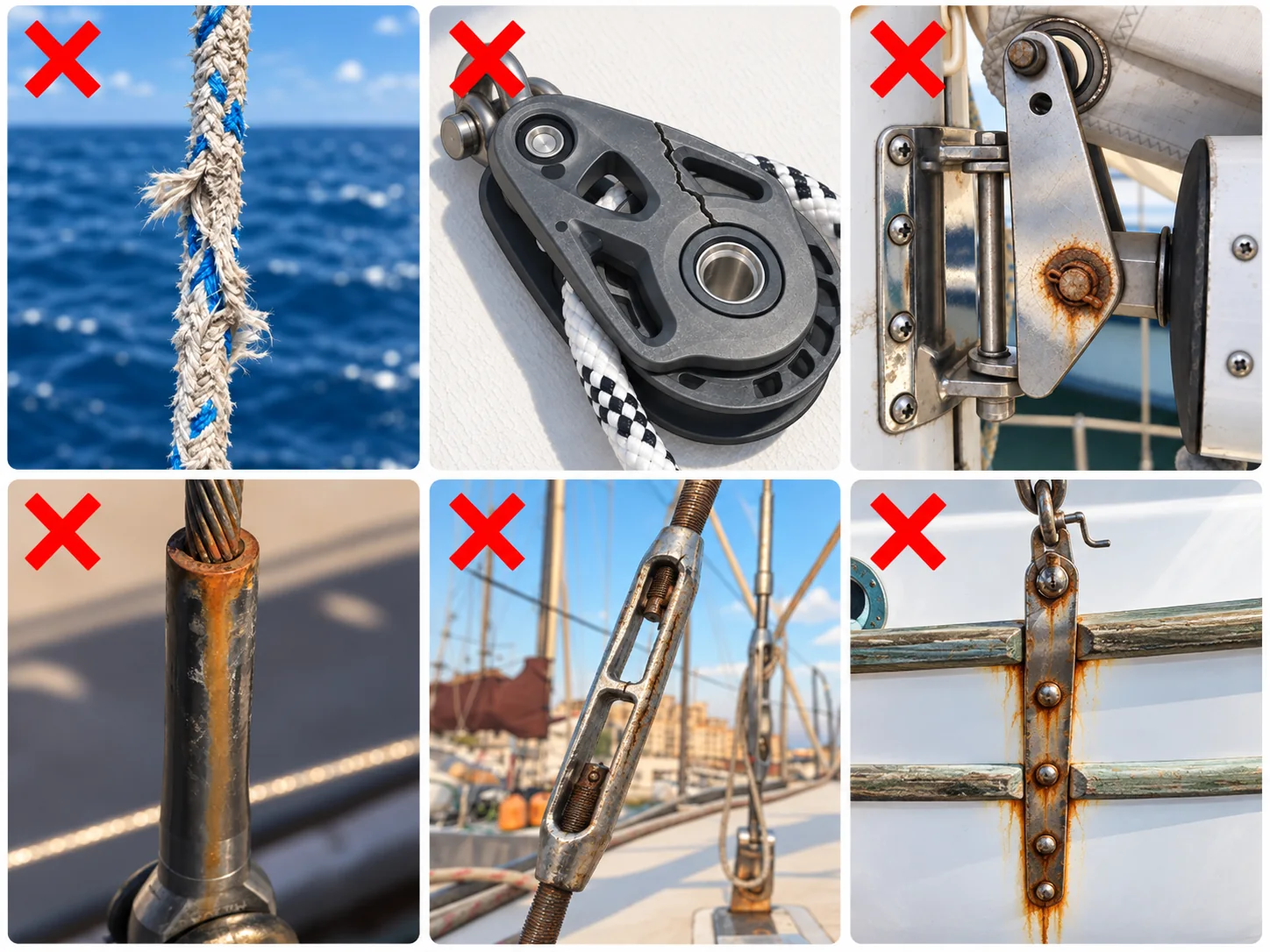
For many sailboat owners, the rig is one of the least understood but most important systems on board. A rigging survey is intended to provide practical, objective information about the visible condition of the rigging and related components. It does not certify the rig as “safe,” but it can identify visible concerns, deferred maintenance, and areas that deserve closer attention.
What is a rigging survey?
A rigging survey is a focused visual inspection of a sailboat’s rigging system. Depending on the scope, it may include the mast, boom, standing rigging, running rigging, chainplates, terminals, turnbuckles, deck hardware, and other accessible rig-related components.
This service can be performed as a standalone survey or added to another survey type. When added to a pre-purchase or other broader survey, it allows for a more in-depth review of the rigging than would normally be provided in a general condition survey.
What does a deck-level rigging inspection include?
A deck-level rigging inspection focuses on rigging components that can be visually assessed from the deck or from other safely accessible areas of the vessel. The exact scope varies by boat, but it may include:
- Mast and boom condition where visible from deck level
- Standing rigging, including shrouds and stays where accessible
- Running rigging condition, wear, chafe, and general arrangement
- Turnbuckles, toggles, cotter pins, clevis pins, and terminals
- Chainplates and surrounding areas
- Spreaders and related visible fittings
- Deck hardware and attachment points related to the rig
- Signs of corrosion, cracking, deformation, leakage, or other visible distress
During a standard survey, I may provide an overall condition statement covering the spars, standing rigging, and running rigging. When a dedicated rigging survey is requested, I provide more detail and a more focused assessment of those components.
What is the difference between a deck-level and a mast-level rigging inspection?
The most obvious difference is that a mast-level inspection involves climbing the mast so upper rigging components can be examined at close range. The less obvious difference is that many surveyors do not offer this service because of the additional risk, equipment requirements, and comfort level involved. This work is often left to a rigger.
Because I am an experienced sailor with in-depth knowledge of sailboat rigging, I am able to offer this service when conditions are appropriate. On many sailboats, roughly 75% of the standing rigging is not readily accessible from deck level. A mast-level inspection allows that remaining portion to be viewed more closely and helps identify visible corrosion, wear, cracking, point loading, damaged fittings, or other potential failure points that may not be apparent from below.
A mast climb also allows for a more detailed inspection of items such as masthead fittings, sheaves, tangs, attachment points, upper terminals, cotter pins, and the upper ends of the stays and shrouds.
Important: I reserve the right to decline a mast climb if I consider the rig or conditions unsafe. When mast climbing is included, I provide my own assistant, and part of the survey cost reflects that added time and support.
Can a rigging survey certify the integrity of my rigging?
No.
A rigging survey is a visual, non-destructive inspection. It can identify many visible concerns, but it does not certify the rigging as safe and it does not guarantee that a failure will not occur. Even relatively new rigging can fail without obvious outward signs.
I do not perform destructive testing, I do not cut rigging open to inspect the interior, and I do not use dye penetrant or other advanced specialty methods. If I find something concerning, the next step may be to consult a qualified rigger for a second opinion and repair or replacement quote.
In practice, a rigging survey helps identify visible issues and informs better decision-making, but it should not be interpreted as a stamp of approval or a certification of safety.
Why use an independent surveyor for a rigging survey?
One advantage of having a surveyor inspect the rig is the clear separation between inspection and repair. I do not perform rigging repairs, so my role is limited to documenting condition and visible concerns as objectively as possible.
That separation helps reduce the potential conflict of interest that can arise when the same person both inspects the rig and sells the repair work. Many riggers are highly skilled professionals, but an independent surveyor can provide an unbiased assessment without any financial incentive to recommend replacement work.
When is a rigging survey worth considering?
A rigging survey may be worth considering when:
- You are buying a sailboat and want a closer look at the rigging
- You own a sailboat and the age or service history of the rig is unknown
- The rigging is approaching or beyond the commonly recommended replacement interval
- The boat has seen heavy offshore use, racing use, or other high-load service
- You have noticed corrosion, cracking, rust staining, loose fittings, or unusual wear
- You want quality-control review of newly installed rigging
- You want a more detailed assessment than what is typically included in a standard survey
Usage matters. A lightly used marina-kept sailboat may wear its rigging differently than an offshore cruising boat or a race boat that has seen frequent loading and harder use.
What does the client receive after the rigging survey?
After the inspection, the client receives a concise written report documenting the visible condition of the rigging and any significant findings. If the rigging survey is performed as a standalone service, the report is typically about 1 to 2 pages. If it is added to another survey type, the rigging findings are incorporated into the larger report.
The report may include:
- A summary of the scope of inspection
- Condition statements for the major rigging components inspected
- Notes on visible deficiencies, corrosion, wear, damage, or maintenance concerns
- Recommendations for further review by a qualified rigger where appropriate
- Photographs of notable areas
How much does a rigging survey cost?
Pricing depends on the size of the vessel, the rig configuration, accessibility, whether mast climbing is included, and whether the service is being performed as a standalone inspection or added to another survey.
Steel Rose Marine Services publishes general pricing information on the website to help clients understand typical costs before requesting a quote. View survey pricing details.
Request a Rigging Survey
Steel Rose Marine Services provides rigging surveys from New Bern, NC, serving sailboat owners and buyers throughout Eastern North Carolina and the Mid-Atlantic. Our goal is to provide objective findings, straightforward reporting, and practical information that helps you better understand the visible condition of the rig.
Request a Survey